MCP Traffic Fingerprinting in Enterprise SIEM Pipelines
Enterprises must detect MCP attacks hidden inside encrypted application traffic.

MCP traffic fingerprinting in enterprise SIEM pipelines means detecting what agents do. Because MCP blends into ordinary HTTPS, network signatures miss the tool calls, credential exchanges, and response patterns that expose abuse. Effective detection requires application-level telemetry tied to agent identity and the user instruction that authorized the work.
Why MCP traffic is structurally invisible to conventional SIEM detection
MCP reverses a familiar client-server interaction. Servers can query and execute actions for connected clients. That inversion creates attack paths that conventional network rules were not written to recognize. A connection can look routine while the actions inside it exceed the user’s request.
The official MCP specification states that the protocol “cannot enforce these security principles at the protocol level.” Implementation choices therefore determine which controls and records a SIEM receives. Network metadata cannot establish whether a tool argument contains an injected command or whether a response includes instructions that redirect an agent. Those distinctions sit inside the application exchange.
Encryption does not erase every useful signal. Timing and size remain visible, but neither explains the meaning of a tool call. OX Security’s analysis of kubectl-mcp-server, CVE-2025-65719, showed how visiting a malicious webpage could let attackers execute arbitrary kubectl commands and take over Kubernetes clusters. Patching that vulnerability closes a specific entry point.
The attack surface SIEMs are missing in production MCP deployments
The postmark-mcp supply chain compromise brought that gap into real workflows. The first publicly documented malicious MCP server was downloaded many times each week before it was discovered, and organizations had already integrated it. Approval and adoption did not establish trust. The malicious server entered through the same deployment path as a useful tool.
OX Security found 9 of 11 public MCP registries compromisable, accepting a proof-of-concept malicious submission without a review process. MCP servers also appear in the vast majority of the cloud environments observed, and a sizable share are exposed to the internet. That leaves both a distribution problem and an external attack surface.
The NSA’s guidance identifies production implementations with no authentication controls at all. Even with authentication in place, exposed credentials give attackers another way in. MCP configuration files have exposed tens of thousands of unique secrets, while AI-related credential leaks have climbed sharply year-over-year. Long-lived agent credentials can still work after the workflow that needed them ends, giving attackers more time to abuse them.
Four attack families whose behavioral signatures SIEMs must learn to recognize
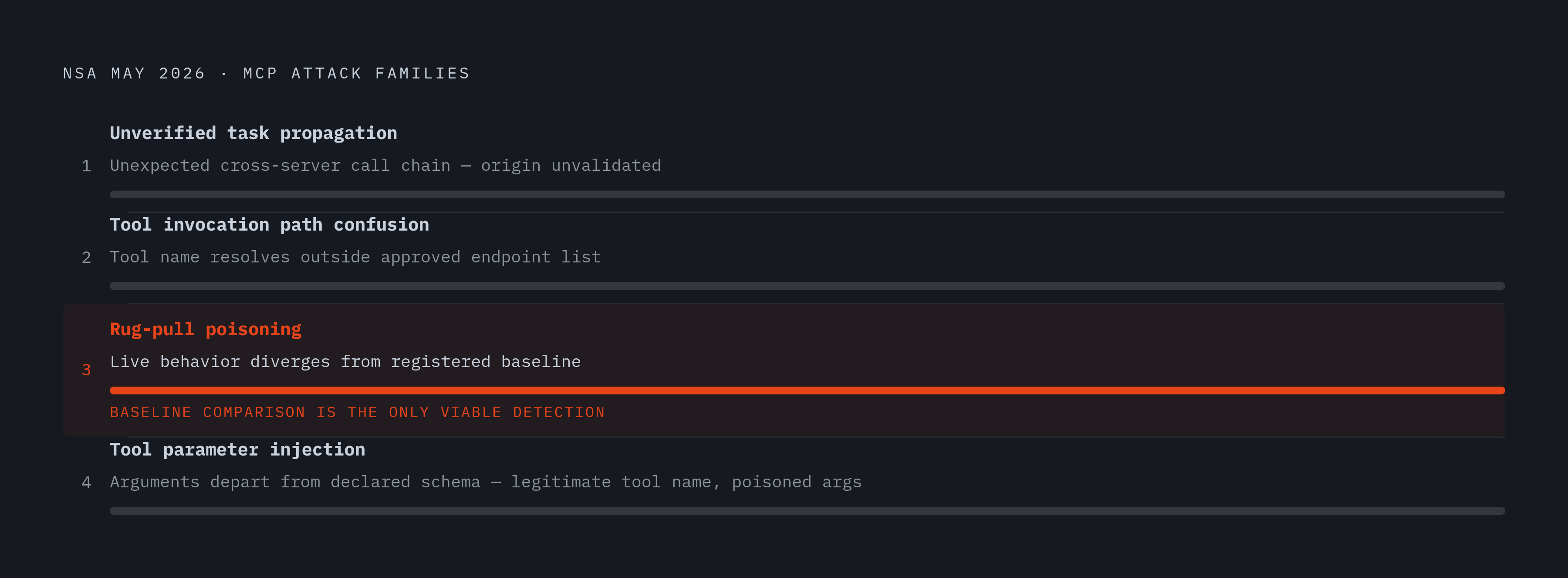
The NSA’s May 2026 guidance names four main exploitation families. Unverified task propagation appears as an unexpected chain of calls across servers or agentic components. Tasks move without validation of origin, scope, or intent, allowing context leakage, overreach, or activation of unrelated downstream tools.
Tool invocation path confusion leaves a different signal. An orchestrator resolves a familiar tool name to an endpoint outside the approved list. Naming collisions in public registries or local modules can cause it to load attacker-controlled code. The name looks acceptable, but the resolved destination is not.
Rug-pull poisoning defeats the assumption that initial inspection is enough. A malicious server advertises a benign instruction at installation, then switches to a malicious one after second usage. Its fingerprint is the change in tool description or response shape after approval. Detection depends on comparing live behavior with the registered baseline, rather than treating onboarding as a permanent verdict.
Tool parameter injection appears in arguments that depart from the schema declared during capability negotiation. Malformed MCP messages pass unsanitized parameters through legitimate interfaces, enabling arbitrary command execution. OX Security found that the overwhelming majority of malicious MCP calls used legitimate tool names with poisoned arguments. An allowlist of names therefore misses the attack’s substance.
What MCP fingerprinting actually means at the protocol and behavioral level
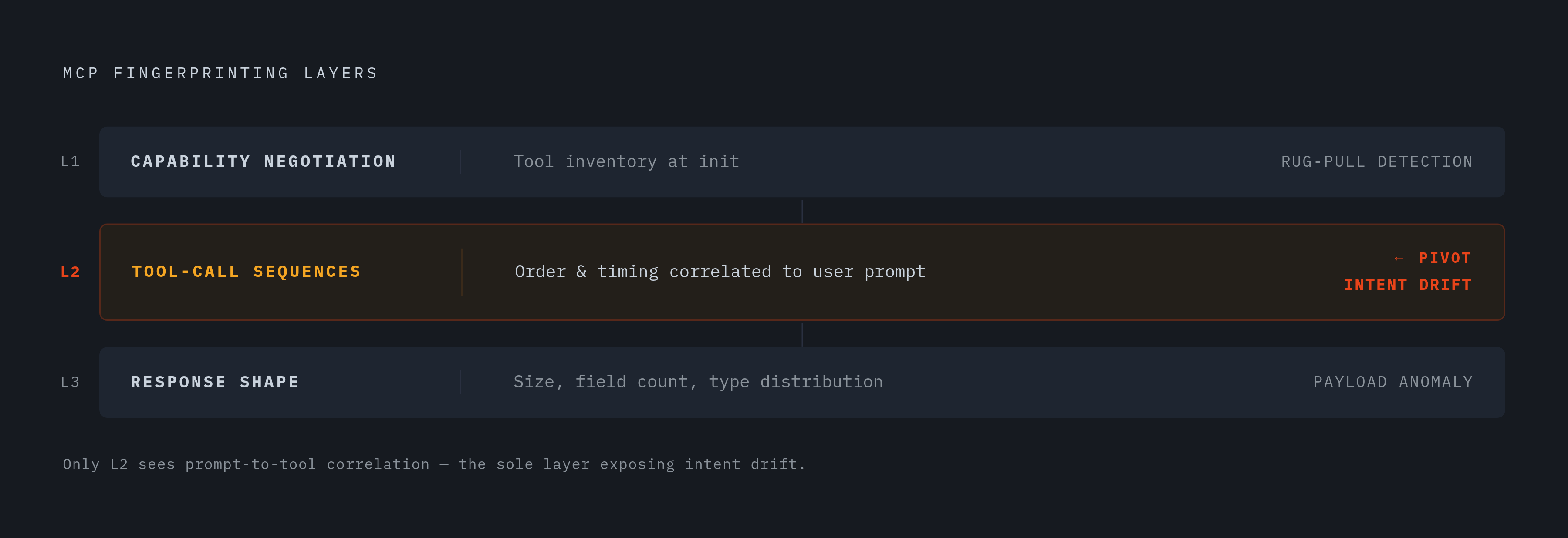
MCP fingerprinting reads structured behavior inside JSON-RPC exchanges. Tool names, arguments, capability declarations, and response characteristics provide repeating patterns that a SIEM can compare over time. Application-level collection exposes those patterns even when TLS hides message contents from network inspection. Three signal layers give the analysis its foundation.
Capability negotiation supplies the first layer. At initialization, the server declares its tool inventory, creating a reference for later comparison. A changed definition can then become a detection event. This is the baseline that rug-pull detection needs, including the registration record against which later sessions can be compared.
The second layer comes from tool-call sequences: the order and timing of calls and how they chain across servers. Consider an agent that queries a database schema, then a file system, then an external API in rapid succession without a matching user instruction. Each call may look legitimate on its own. The sequence exposes the departure from the authorized task, making prompt-and-tool correlation essential for detecting intent drift.
Response shape supplies the third layer. Size, field count, and data type distribution can distinguish routine output from possible bulk extraction. A response orders of magnitude larger than a tool’s baseline is a useful fingerprint, especially when the pattern persists across calls. Size and timing are still visible with TLS, but field-level analysis needs access to the application.
SentinelOne describes three complementary detection mechanisms, including parameter-level command-injection filtering, statistical analysis of sequence and timing, and semantic comparison of instructions with tool invocations. Authentication adds another structured signal. The July 2026 MCP specification revision, 2026-07-28, hardens the OAuth 2.1 resource-server posture established in June 2025 and continues to mandate OAuth 2.0 Protected Resource Metadata, RFC 9728. Credential telemetry can show whether a client follows that authorization-server discovery flow or bypasses it.
Why identity is the missing dimension in most MCP SIEM integrations
A behavioral alert still needs an attributable actor. When a long-lived credential is reused, an unusual sequence may come from a legitimate agent going beyond its task or an attacker replaying stolen access. The SIEM sees activity without a reliable explanation of authority. Identity must therefore connect each invocation to its scope and credential history.
The NSA recommends least-privilege authorization for each invocation. Its guidance also recommends cryptographically binding messages to time and context to prevent tampering and replay. These controls make authorization specific to the action. They reject the idea that connection-time approval is enough.
The Coalition for Secure AI recommends exchanging user-provided OAuth tokens through the authorization server using RFC 8693. That exchange produces an operation-scoped token and an auditable record the SIEM can ingest. HashiCorp Vault, now part of IBM, announced native AI agent support in May 2026 with ephemeral per-request authorization and automatic expiry. Microsoft’s Entra Agent ID, generally available from April 2026, provides per-agent identity, lifecycle management, and integration with Conditional Access and identity protection.
Building the SIEM pipeline: ingestion, parsing, and correlation rules for MCP telemetry
The engineering response starts with the collection point. A centralized gateway proxy is the preferred place to intercept MCP exchanges and produce structured logs. SentinelOne describes a gateway that validates JSON-RPC structure, limits message size, and strips unnecessary metadata. Cloudflare MCP server portals reached general availability on 24 September 2026, offering one endpoint for many servers with Access policies, MFA, device posture, HTTP logging, DLP, and Logpush to a SIEM.
Collection need not depend on that deployment model. For Kubernetes-hosted servers, a sidecar can record tool calls to an OPA policy engine without modifying the MCP server. OpenTelemetry provides an emerging common transport for MCP traces. The same trace data can feed security, observability, and compliance systems without separate collection pipelines duplicating the work.
Parsing must preserve the evidence that name-only logs discard. Each event should include the tool name, full parameter set, agent identity token, session-start capability baseline, response size and field count, and a sequence identifier linking the call to its chain. SentinelOne specifies logging tool invocations with parameters, authentication attempts, resource access, and scope violations. Parameters are not optional detail for this purpose. Without them, a legitimate call name conceals an injected argument.
Correlation then has to work across calls. A sequence rule can detect a tool used in one context followed within a defined interval by a tool in another context, without a matching instruction in the prompt log. A standing comparison can flag live tool descriptions that differ from the recorded capability baseline. Historical registration records remain necessary so that a fresh session does not silently legitimize a rug-pull change.
Other rules need different comparison windows. Exfiltration detection can look for response sizes exceeding a tool’s historical baseline by a defined multiple across several calls in a session. Intent-drift detection compares the original prompt with the tool sequence that follows it instead of just searching either record for a signature. That semantic comparison is the most computationally expensive rule type and should be applied selectively to high-privilege tools. Tamper-proof audit records keep that chain of evidence intact for investigation and oversight.
What the current tooling landscape covers and where it leaves gaps
Available tools cover useful parts of this architecture. Wiz MCP Security, generally available in July 2026, scans cloud accounts for deployed MCP servers, scores configuration, and feeds runtime events into its existing CNAPP. It is best suited to cloud-native inventory and configuration posture. That addresses discovery and exposure, but those functions are not the same as correlating a user instruction with a cross-server call chain.
The K8s MCP Server sidecar offers a narrower open-source starting point. It records every kubectl-equivalent call to an OPA policy engine, making it useful for Kubernetes-hosted deployments. Its value lies in that specific collection and policy position. Identity context still has to come from elsewhere.
The broader gap is between collecting events and explaining them. No single tool in the described landscape covers runtime observability, behavioral baselining, policy enforcement, and audit logging with identity context attached throughout. Enterprises therefore need to compose capabilities or build the identity-correlation layer themselves. SIEM-native integration and cross-tool sequencing remain substantial engineering work.
Detection coverage also has a hard limit. Current tools catch many known patterns, but novel prompt-injection attacks remain largely undetectable. Fingerprinting is consequently an evolving detection practice. A product that supplies useful telemetry does not remove the need to revise baselines and correlation rules as attacks change.
Operationalizing MCP fingerprinting: what security and platform teams need to do differently
The practical shift is shared ownership from registration onward. Security and platform teams should treat MCP server registration as a security event, capturing capability records and retaining them as the baseline for subsequent behavior. Discovery comes before that baseline can exist. The NSA recommends scanning for open, unauthorized, or vulnerable MCP servers, making inventory the prerequisite.
Platform engineers should expose structured OpenTelemetry traces as the SIEM’s authoritative record. Those traces need the tool name, full parameters, agent identity token, response size, and session chain ID. Security teams should use them to build sequence- and session-level rules instead of expecting isolated application logs to reveal the chain after an incident. That division of work makes context available where detection needs it.
The EU AI Act’s enforcement provisions applied from 2 August 2026 for transparency, GPAI, and certain prohibitions, while high-risk AI rules were delayed to December 2027. The Federal Reserve, OCC, and FDIC revised Model Risk Management guidance in SR 26-2 in April 2026, but that non-binding guidance explicitly excludes generative and agentic AI. Neither timeline justifies claiming that every MCP pipeline already faces the same audit obligation.
The operational case does not depend on that claim. A security team needs to distinguish an authorized workflow from stolen access, poisoned arguments, or a server that changed after approval. That requires platform teams to expose the evidence before an incident and security teams to correlate it with identity and intent. Otherwise, the SIEM records a normal HTTPS connection while the agent does something the user never asked for.