AI Control Plane Architecture for Single-Pane MCP Visibility
Enterprises need central governance to scale AI agents safely beyond MCP's connectivity layer.
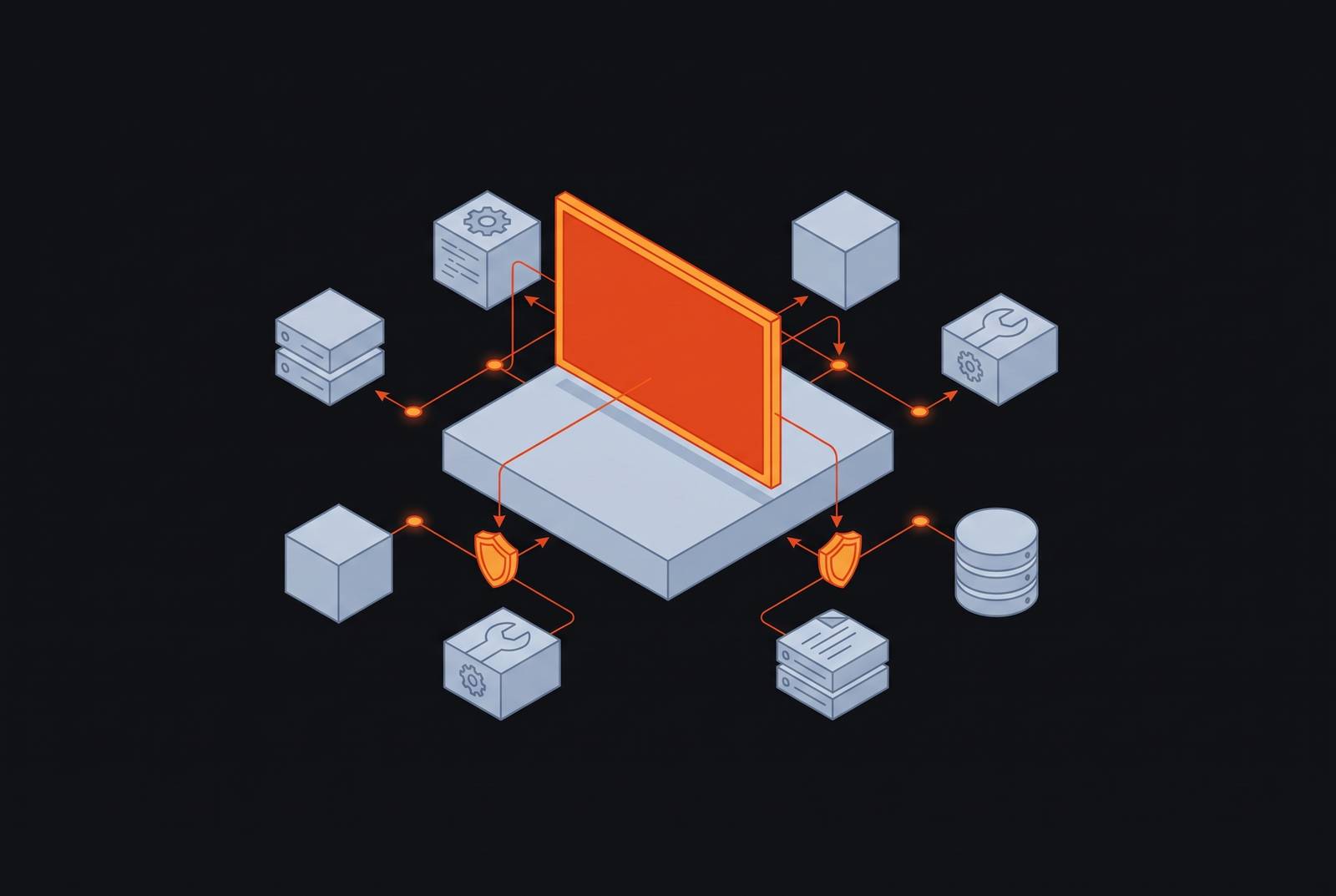
Rolling out AI agents to thousands of non-technical employees takes more than a catalog of tools. It takes an AI control plane that gives employees an approved path to agents while giving IT one view of every MCP server, identity, and tool call. This architecture adds the governance MCP leaves out, so more employees can have access without each having to become a security expert.
Why MCP's design creates a governance vacuum enterprises cannot patch their way out of
The Model Context Protocol, or MCP, gives AI agents a universal interface to external tools and data [1][2][3]. Its purpose is connectivity, so agents can use those resources through a common protocol. That is a useful foundation for enterprise agents. Instead of treating each tool connection as a separate problem, MCP gives developers a shared way to connect them. It does not, however, supply the enterprise-wide authority that decides which connections are acceptable.
The gap is part of the design. Cloud Security Alliance’s May 2026 research note explains that the MCP authorization specification defines an OAuth 2.1 framework but marks authorization as optional for implementations [1][2][3]. Anthropic has described the STDIO command-execution behavior as intentional and declined to modify the protocol architecture, leaving remediation to downstream developers. These are not simply missing patches. Fixing implementations one by one does not add a native registry, an identity layer that works the same way throughout, cross-server policy enforcement, or central audit.
At enterprise scale, that missing layer becomes an operating problem. Teams choose their own servers, employees connect personal credentials to enterprise data, and IT lacks an inventory of what is running. MCP has reached hundreds of millions of monthly SDK downloads, and a large share of software technical leaders report production use. Yet only an estimated 11–14% of enterprise agentic pilots reach production, with identity, audit, and access-control gaps stalling the rest. Connectivity alone does not get a pilot into production.
What happens when multiple MCP servers operate without a central governance layer
Each MCP server managed on its own adds an access boundary that someone has to defend. Without a common control point, the organization cannot count on authentication or encryption being in place at all those boundaries. Trend Micro found 492 MCP servers exposed to the internet with no client authentication or traffic encryption. CSA’s note also cites a July 2025 internet scan that found MCP instances responding to unauthenticated requests.
Credentials make that exposure more consequential than an isolated tool connection. An MCP server can hold credentials for multiple enterprise systems behind one interface. If that server is compromised, every system those credentials reach can be exposed through the same point of failure. Broad tokens enlarge the reach of that compromise. A central inventory and credentials with a narrow scope solve different parts of this problem, because knowing a server exists does not limit what its credentials allow.
OX Security’s April 2026 disclosure described STDIO behavior in Anthropic’s official MCP SDKs for Python, TypeScript, Java, and Rust that passes parameters directly to the host OS shell without sanitization. An attacker who can change the MCP configuration file can thus cause arbitrary code execution on that host. CSA describes this as a design default propagated through downstream projects. Registry control cannot rewrite the SDKs, but it can set and enforce limits on which servers agents may reach.
Tool poisoning operates at a different boundary. Tool descriptions enter the LLM’s context window and are rarely displayed in full to users. An attacker controlling a description can insert instructions the model treats as authoritative while the user sees nothing. That runtime problem calls for controls over individual tool invocations and inspection that understands the content of those calls.
What a control plane actually is and how it differs from a gateway or a point security tool
A control plane defines and coordinates the rules, while a gateway enforces them where calls pass through. The relationship resembles a firewall’s policy engine and its rule enforcer. Neither replaces the other in this architecture.
A standalone scanner, identity provider, or logging tool addresses one slice of governance. An AI control plane joins the LLM gateway, MCP gateway, identity, policy, and observability so the same rules and identity context apply across model calls, tool calls, and agent sessions. The single pane is more than a dashboard. It lets teams connect which servers are running to which agents use them, who initiated each action, and whether each call succeeded or failed. Separate screens cannot supply that common authority merely by displaying related data.
The five layers a production-ready MCP control plane must include
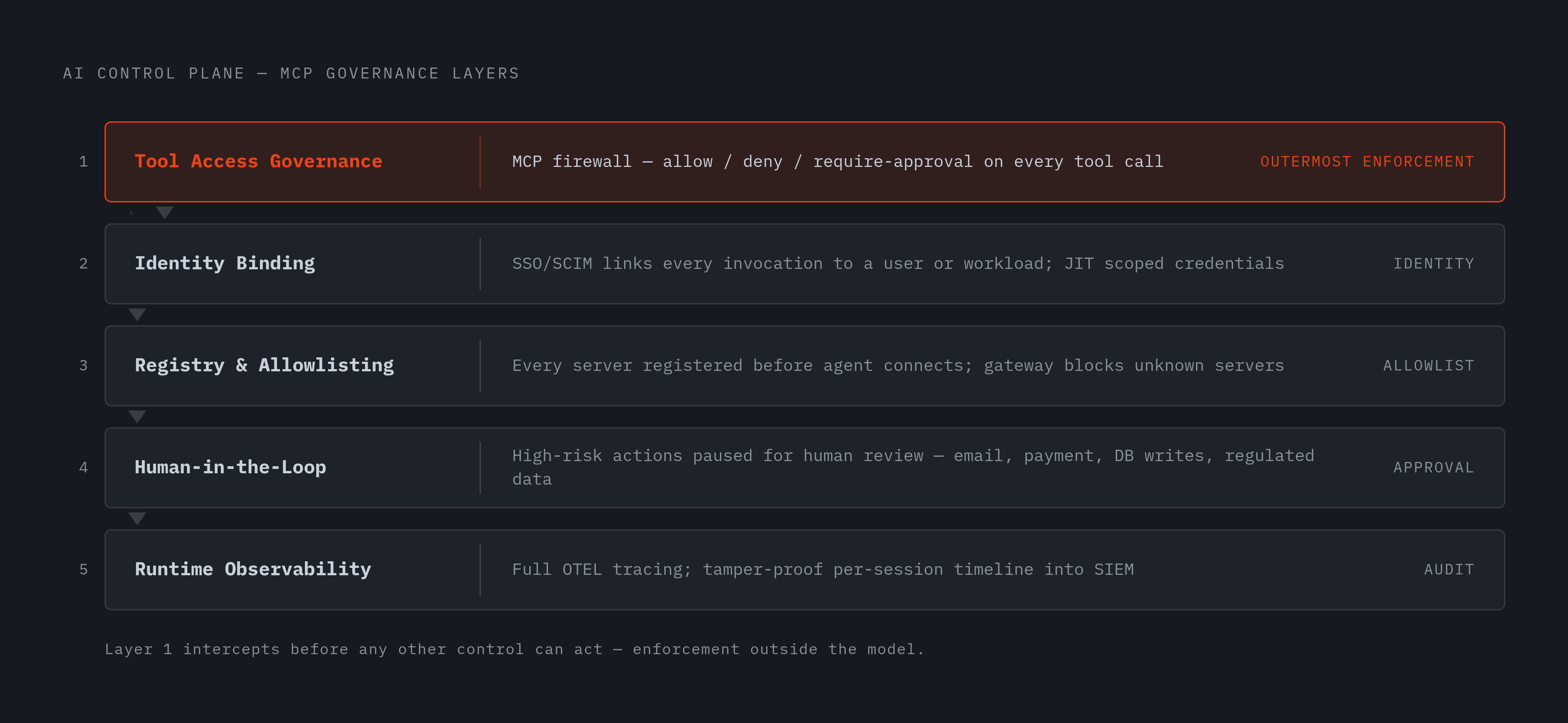
The first layer is tool access governance, often called the MCP firewall. It intercepts every tool call before execution and applies allow, deny, require-approval, or require-justification rules. Policy is typically expressed as YAML with CEL or OPA expressions. A finance workflow, for example, can be barred from calling file-write tools outside the expense platform. Tool allowlists for each agent are the strongest single control against tool poisoning and cross-server attacks, because the action a model proposes still has to pass a permission check outside the model.
The second layer binds identity to every tool call. Each invocation must identify the initiating user or workload, with enterprise SSO and SCIM linking that identity to automatic provisioning and de-provisioning. Credentials should be issued just in time. These short-lived credentials should be scoped to the system and task, rather than giving an agent a standing token with broad access. CSA’s note highlights deployments that announced OAuth support while granting tokens blanket access to backend APIs, so an expense-report agent should receive access scoped to the expense system.
The third layer is a registry with discovery and allowlisting. Every server must be registered before an agent can connect, and the gateway must block unregistered servers. A passive directory is not enough for this role. The registry turns otherwise hidden MCP use into a managed inventory, showing which servers exist, which agents use them, and which remain unused or unreviewed.
The fourth layer pauses high-risk actions for human approval. Routine calls do not all need review, but actions such as sending email, executing a payment, modifying a database record, or reaching regulated data should be pausable. Review must fit the employee’s working flow. Slack-native approval or approval inline in the agent interface can keep the process from erasing the efficiency agents are meant to provide. The decision must also go into the audit trail, so the permission is linked to the action it allowed.
The fifth layer combines runtime session observability with tamper-proof audit logs. It records a durable timeline for each agent run, including every tool call, model call, policy decision, approval, and error, with timestamps and linked artifacts. A log file alone is not enough. The structured trace must let a reviewer reconstruct what the agent did, on whose authority, and with what result. Full OpenTelemetry, or OTEL, tracing lets that timeline flow into existing SIEM and observability infrastructure.
How single-pane visibility changes what platform and security teams can actually do
Without a shared view, platform teams have to check each server and ask each team for answers. The inventory relies on what people in each team know, and teams must find the systems involved before they can investigate. A control plane makes those answers available on demand. A platform engineer can see registered servers, active use, agent-to-tool relationships, and failing calls in the same operational view. That is routine awareness for API gateways, but it has been absent from MCP deployments.
A team installing a new MCP server no longer creates an automatic exception to governance. The server is registered and subject to policy, or the gateway blocks access. When agents try to reach unregistered servers, teams can see those attempts as policy violations. Security review then relies less on each team remembering to ask before it connects another tool.
To spot signals of tool poisoning, prompt injection, intent drift, and exfiltration, teams must check tool-call content against what the agent is expected to do. A generic SIEM receiving forwarded logs cannot make those judgments without MCP-layer context. Identity binding also gives an investigation a precise starting point. An alert can lead beyond a generic service account to the specific user, agent, and workflow.
That changes the role of governance in employee enablement. Instead of manually policing separate deployments, security teams provide the common infrastructure through which approved use can expand. Non-technical employees can take an approved path without having to manage servers or credentials themselves. The approved path becomes the easy path. This is how a single pane supports broad deployment rather than serving only the specialists who operate it.
The compliance dimension: why audit depth matters beyond security operations
For enterprises using regulated data, missing per-action records create compliance exposure as well as an investigation problem. Auditors need to reconstruct what an agent did, on whose authority, against which data, and with what outcome. A successful session status cannot answer those questions. Neither can a model-level log that omits tool actions or approvals. The minimum useful artifact is a tamper-proof, identity-linked record of the agent session.
The EU AI Act’s transparency duties apply from August 2026, with the high-risk regime applying from December 2027 after the Digital Omnibus. These obligations make audit depth relevant beyond the security operations team, including for high-risk agent actions involving regulated data through MCP gateways. The audit layer therefore serves two purposes. The same record used to investigate a suspicious call can support a human reviewer reconstructing the action after the fact, rather than requiring a separate compliance record assembled later.
CSA’s research finds that only a small fraction of organizations have formal enterprise-wide agent identity strategies or high confidence that their IAM can handle agent identities. That leaves a gap between deployment and accountability. Each agent put into use without an identity-linked action trail makes it harder to explain what it did later. Compliance infrastructure must do more than keep more data, because the record it keeps must link who had authority to what was done and how it turned out.
How do you choose a platform for non-technical employees without overwhelming IT?
The architecture favors a unified platform over a stack of point tools because every integration seam can lose identity context, policy, or audit data. A scanner may find a problem without controlling access, while an identity provider may authenticate an agent without limiting which tool calls it can make. Logging can record activity without linking it to the policy that allowed it. Those tools can contribute useful functions. Those tools must operate as one governed system or leave the buyer responsible for joining the pieces.
A registry must both list approved servers and block access to unregistered ones. Identity must reach every action through SSO, SCIM, and just-in-time credential issuance, while policy must extend from the session or model level to individual tool-call depth. Detection must understand MCP events, including tool poisoning, prompt injection, intent drift, and exfiltration. Tamper-proof logs and full OTEL tracing must preserve that context into existing security and compliance workflows.
Employee access is part of the same evaluation. A developer-only platform leaves non-technical staff outside the approved path and recreates the uneven adoption that produces shadow MCP. The enablement layer should support agent setup from tools such as Slack and access to a broad catalog of pre-vetted MCP servers. Ease of use has to lead employees through the same identity, policy, and audit controls used elsewhere.
Choose a platform that applies the same identity, policy, and audit trail to model calls, tool calls, and agent sessions in a single view without requiring the buyer to assemble those layers separately. For enterprise employee enablement, a platform with these shared controls lets each new group of users inherit a governed path, while assembling those layers separately creates another integration project for IT.