Blast Radius Containment When One AI Team's MCP Credentials Are Compromised
Scoped, short-lived credentials limit damage when MCP hosts are compromised.
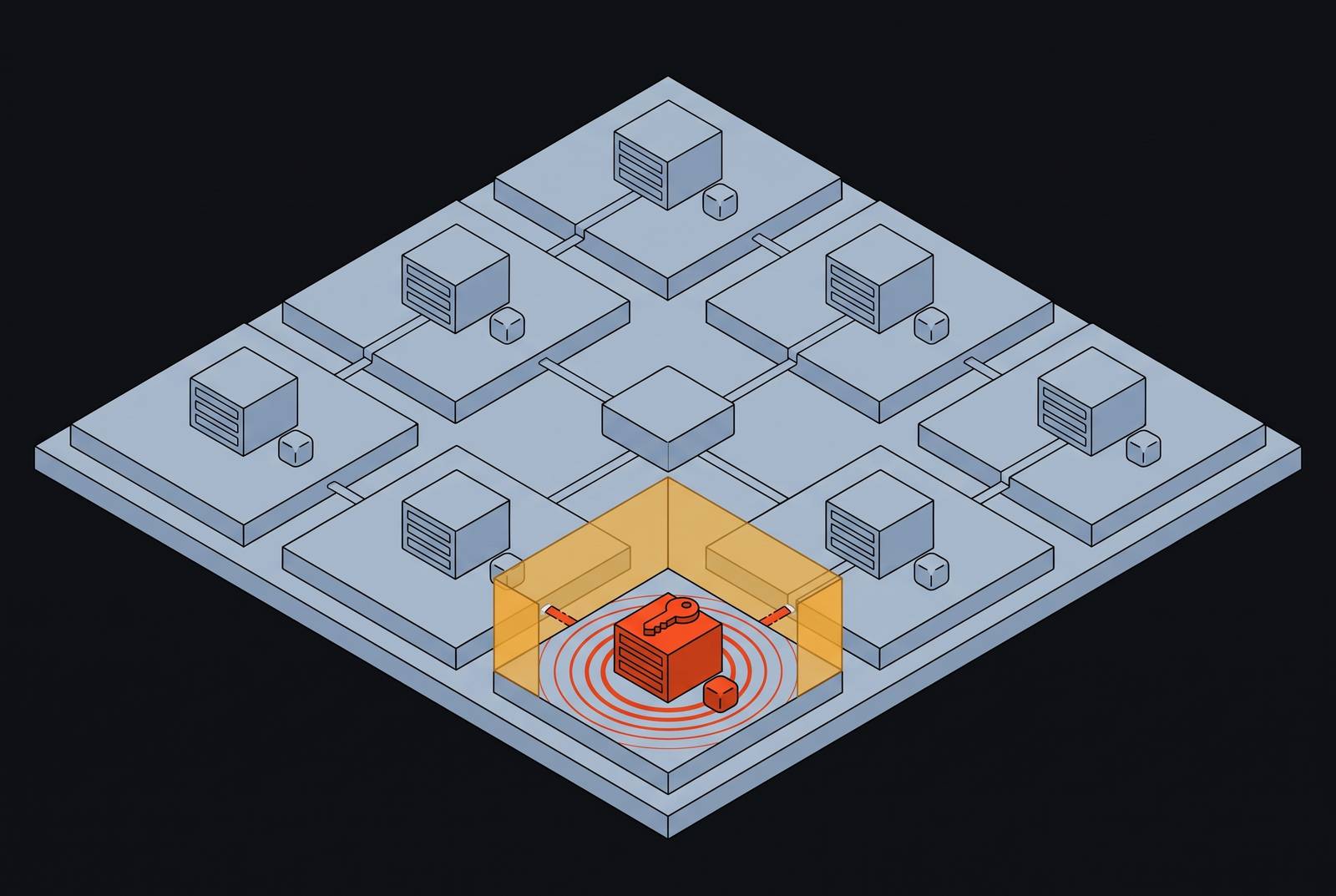
A unified MCP control plane for platform engineering teams should put credential handling, team access rules, tool-call permissions, and emergency containment on one foundation. Containing the blast radius when one AI team’s MCP credentials are compromised requires more than detecting stolen keys. It requires scoped, short-lived credentials and enforced team boundaries, so that one compromised host does not become a route across the enterprise.
Why a single compromised MCP credential can reach every system a team touches
A single MCP host accumulates credentials for every server it connects to, including Notion, Linear, GitHub, and a Postgres database. It holds the union of their access scopes at once. That makes the host a concentration point for access. An attacker who compromises the machine can get all those credentials at once, while one stolen credential gives the attacker whatever access its scope allows.
MCP standardizes tool discovery and invocation but leaves authentication, authorization, and transport security to implementers. The NSA’s Artificial Intelligence Security Center spelled out the gap in its May 20, 2026 Cybersecurity Information Sheet. MCP defines no role-based access control model, and authentication is optional. Developers therefore store API keys in .env files, mcp.json configs, and environment variables scattered across machines, following a pattern normalized for speed.
How large the credential exposure surface already is across enterprise MCP deployments
Hush Security’s September 17, 2026 scan of approximately 82,000 public MCP configuration files found roughly one in eight credential slots hardcoded. Nearly a quarter of those hardcoded credentials were both non-expiring and broad in scope. The combination is more dangerous than volume alone. A broadly scoped credential opens more systems or actions, while a non-expiring credential preserves that access until someone manually revokes it. Public configuration files can therefore serve as a directory of access points with the keys already attached.
An attacker does not need to begin with a chosen organization when those files are publicly accessible. Predictable credential storage, broad permissions, and indefinite validity turn discovery into a potential persistent foothold. Defenders therefore need to identify every system that accepts an exposed secret as well as protect the secret itself. Removing the public file does not, by itself, revoke the credential.
Even building that inventory is difficult when credential requirements are not declared consistently. Only a small fraction of servers in the official registry declare those requirements in structured metadata. The rest describe authentication informally in READMEs or not at all. Security teams cannot easily enumerate exposure from the registry alone.
What lateral movement looks like once a credential is taken from one team's MCP setup
The Supabase/Cursor tool-chaining case shows how an agent can turn access to one source into access to another. An attacker embedded instructions in a support ticket, which the agent read through execute_sql. The agent treated that text as user intent. It then issued another execute_sql call against the integration_tokens table and wrote stolen integration tokens back as a new message on the public-facing ticket.
CloudSEK’s June 2026 AIVigil case shows a different path through infrastructure. A fully unauthenticated MCP server endpoint chained into server-side request forgery, local file inclusion, and credential exfiltration. The exposed endpoint was only the starting point. The chain reached live AWS IAM credentials and plaintext database credentials stored in environment variables.
One compromised internal agent can pass injected instructions to other agents that trust it, allowing the compromise to propagate beyond its original task. Agent trust becomes another route across boundaries. Google’s MCP Toolbox for Databases also contained an HTTP client that followed redirects without validating their destination, illustrating the danger of unchecked destinations in connected tooling.
Why overpermissioning makes the blast radius structurally wider before any attack occurs
Credential storage explains where access can be stolen. Permission scope explains how much that theft buys. Many enterprise agents arrive at their first tool call already overpermissioned because teams outside security or engineering choose the broadest available access to get the agent working. Without enforcement, nothing pushes back on that choice. The blast radius is expanded during provisioning, before an attacker takes any action.
The nginx-ui CVE-2026-33032 case shows the extreme end of that gap. The March 2026 vulnerability, with a CVSS score of 9.8, involved an MCP message endpoint that performed no authentication for command execution requests. Attackers could restart the server or change configuration files and take over the nginx service completely. The permission model was simply absent there. No subtle manipulation of an otherwise narrow permission was needed.
Overpermissioning is therefore a governance failure. Most organizations have no documented policy for what an AI agent is allowed to do, while MCP’s lack of native role-based access control creates no forcing function before deployment. Fast setup becomes the practical default instead. Detection may reveal misuse later, but it cannot undo the decision to grant broad access in advance. Containment has to begin where permissions are issued.
How the credential isolation controls — least privilege, JIT issuance, and identity binding — actually limit what an attacker can reach
For teams implementing containment, the first control is least-privilege credential scoping per team and task. Instead of a broad API credential, the agent receives a token limited to the current work. Its scope becomes a hard access limit. If prompt injection, a model reasoning error, or stolen configuration hijacks the session, the attacker can use that token only within the permissions it has. Scope limits lateral reach even when the agent’s behavior is no longer trustworthy.
Just-in-time issuance adds a limit on duration. Short-lived, task-scoped tokens expire at the end of the task, removing their value for later reuse even if they were extracted from memory or recorded in an audit trail. Expiry does not protect the entire active session.
Each agent should have its own identity and service account because shared credentials obscure attribution and expose every agent using the same secret. Sub-agents need their own authentication for the same reason. Passing an orchestrator’s credentials down the pipeline gives each recipient access beyond its specific subtask and turns compromise of the orchestrator into a pipeline-wide risk. Independent, minimal permissions keep delegation from becoming permission inheritance.
The June 2026 Enterprise-Managed Authorization extension to the Model Context Protocol, first implemented by Anthropic, provides a shared basis for server access decisions. Standard MCP authorization requires authentication to every server individually. The extension authenticates once through the organization’s identity provider and scopes server access to the user’s groups and roles. The identity provider becomes the authoritative decision-maker instead. This reduces reliance on separate local access configurations without replacing task-level permission limits.
The September 2026 MCP OAuth SDK disclosures described flaws in both the TypeScript and Python SDKs that let a malicious server redirect client OAuth credentials to an attacker-controlled authorization server. Updating the SDK alone was not enough. Teams also needed to pass expectedIssuer in TypeScript or issuer= in Python to close the residual gap for bundled credential providers.
Why isolation boundaries between teams are what prevent one compromise from cascading enterprise-wide
Credential controls limit what a compromised session can do, but team boundaries determine where that session belongs. Without isolation, a broad API credential on one team’s host can function as an enterprise credential wherever it is accepted. Other teams need not have intended to share access. Acceptance of the same secret is enough to create the connection. A team-level incident stays local only when access rules prevent that connection from crossing the team boundary.
Because MCP has no native role-based access control model, the layer above the protocol must enforce those boundaries. The platform layer must enforce policy for each tool call as well as at the network perimeter. A reachable server can expose tools with different purposes and different permission requirements. The relevant boundary is whether this identity, in this team’s context, may make this tool call.
SSO and SCIM integration connect access and account lifecycle controls to named identities, making boundary crossings attributable and reviewable. That accountability lets teams use the enforcement record to trace a credential when it appears outside the team where it belongs. CISA added LiteLLM authentication bypass to its Known Exploited Vulnerabilities catalog on September 2, 2026. CERT-EU’s September 2026 Cyber Brief also flagged LLM-jacking, in which stolen AI API keys are reused or resold for unauthorized workloads, showing why credential reuse cannot be treated as a merely theoretical concern.
What real-time detection and emergency containment add to structural controls when prevention is not enough
A correctly scoped credential can still be abused during its valid session. Prompt injection can also push an agent away from its intended task without first changing its permissions. Structural controls limit what the agent can do in those cases. Real-time detection must identify the misuse that fits inside those restrictions, including unauthorized access attempts, unexpected tool use, unusually large data retrieval, and signs of injected instructions. That requires seeing tool calls as well as network traffic.
A tool call may look legitimate on its own but suspicious when viewed alongside what else happened in the session. Detection needs to take into account how the agent is expected to act. Tool poisoning, prompt injection, intent drift, and exfiltration require logic built for agent activity rather than general-purpose security rules relabeled for MCP. Tamper-proof logs tied to individual agents, rather than shared service accounts, make it possible to establish who acted, in which team’s context, and when.
The platform needs the ability to suspend permissions immediately, invalidate credentials or tokens in real time, and, where technically feasible, roll back a workflow to its state before the problematic action. Human review cannot be the only stop mechanism. An automated agent can continue acting while a ticket waits for approval, so a warning without immediate enforcement leaves the session active. An emergency kill switch is a hard requirement.
How do platform teams centralize MCP governance on one foundation instead of three?
An agent builder, a gateway, and a security tool bolted together can divide the very context containment depends on. Each seam can lose identity, leave a policy unenforced, or break the audit trail. Separate tools are not a shared control plane. The architecture works only if enablement, access decisions, and security operate from the same identity and policy foundation. Otherwise, each AI project inherits another integration problem before it can inherit reliable controls.
For platform teams choosing that foundation, the criteria are concrete. OAuth and credential handling should be built in, SSO and SCIM should connect identities to tool calls, and policy should be enforced at tool-call depth. Teams should not rebuild that plumbing for each project. A governed catalog should provide access to a large catalog of MCP servers instead of scattering ad-hoc configurations across developer machines. Least privilege, just-in-time credentials, isolation, and emergency containment then become shared platform capabilities.
That division of responsibility changes the role of security and IT. When every team must assemble its own controls, those functions become gatekeepers for repeated exceptions and custom access work. Teams gain a governed route to MCP servers, while security gains a consistent place to constrain access and stop misuse. The platform’s job is to make adding another AI team routine without making that team’s compromise an enterprise-wide event.