Audit Sovereignty in Multi-Team MCP Environments Where Governance Cannot Be Delegated Away
Centralized audit logs are required to govern agent access across fragmented MCP servers.
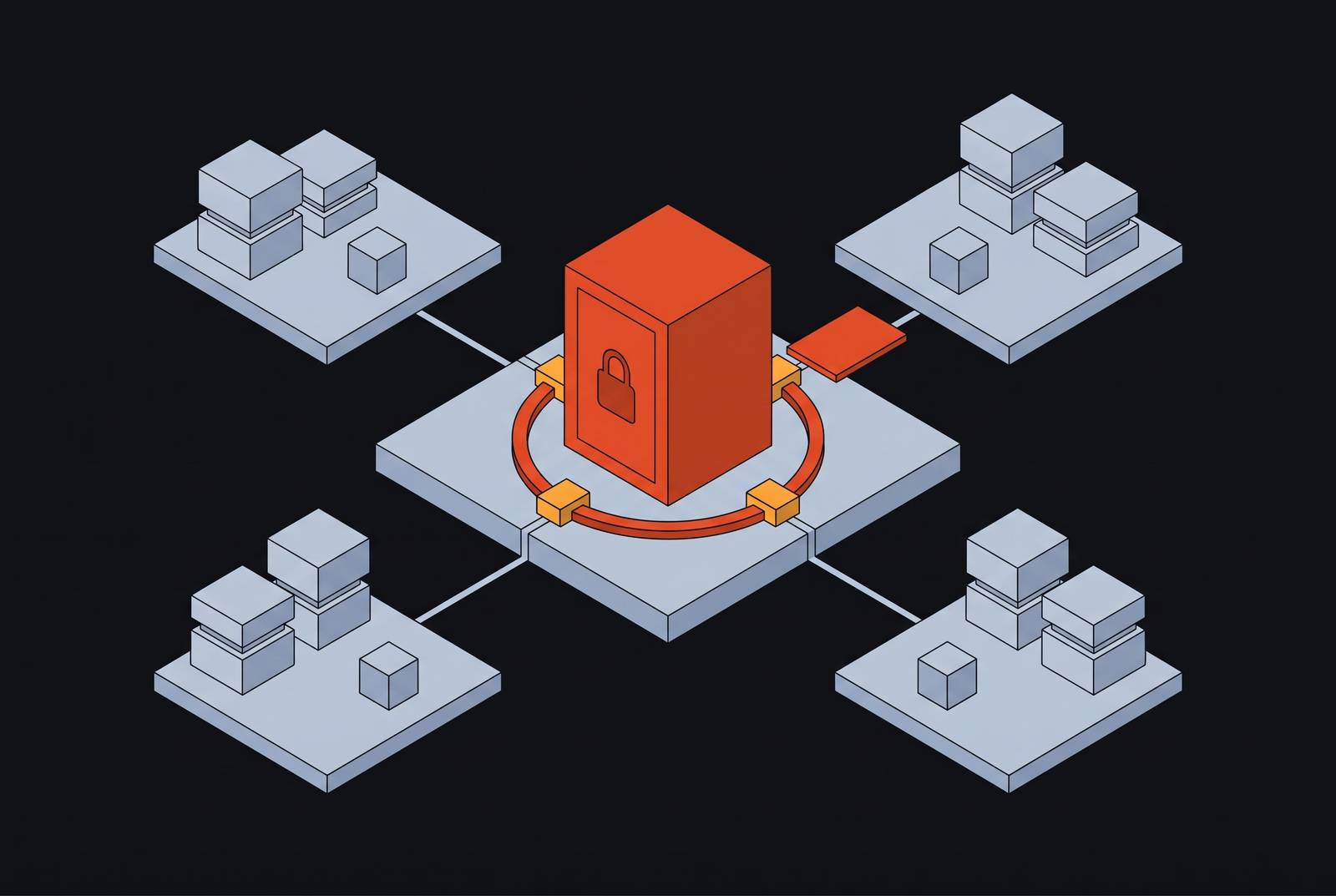
A unified MCP control plane for platform engineering teams must give the enterprise control over agent identity, per-call authorization, tool integrity checks, and cross-server audit records. That lets teams share MCP access controls without rebuilding security for each AI project. Audit sovereignty means this authority sits outside the agents and individual servers it governs, because no team’s local logs can account for an agent’s actions across the enterprise.
Why MCP became a governance liability before enterprises could govern it
Anthropic released MCP in late 2024 to standardize how AI agents connect to tools, databases, APIs, and file systems. Before that, each pairing of a tool and a model needed a custom connector, which created an N×M integration problem. MCP made that work easier with a common interface. The original specification shipped without a mandatory authentication framework and relied on an implicit trust model that treated MCP servers as benign.
That design left adopters responsible for controls the protocol did not supply. The NSA’s May 2026 security advisory said that MCP cannot enforce consent, privacy, or tool-safety principles through the protocol alone. A working connection therefore does not establish a governed connection. Between January and April 2026, dozens of CVEs were disclosed against MCP implementations across Python, TypeScript, Java, and Rust SDKs. The exposure spans implementations rather than one isolated server, while the underlying interface connects agents to enterprise systems.
How multi-team deployment turns a protocol-level gap into an audit-level collapse
When teams deploy MCP on their own, their choices add up to permissions that no one team can check in full. Credentials accumulate in servers that connect to multiple enterprise systems, making a compromised server a route into every system whose credentials it holds. Without a common credential lifecycle, no single party is accountable for revocation across the environment. A team can secure its own connection without knowing which other connections depend on the same access.
Shared agent logins make that problem harder to trace. They collapse per-agent scoping, action attribution, and selective revocation into one shared identity. When sub-agents inherit an orchestrator’s permissions, access also spreads beyond the task that justified it. Each sub-agent should instead authenticate independently with minimum permissions for its specific subtask. Yet only a small minority of deployed MCP servers implement tool-permission scoping, leaving most connected agents with effectively all-or-nothing access.
Wiz Research’s disclosure of CVE-2026-12957 in the Amazon Q VS Code extension shows how those boundaries can fail together. A malicious repository used a crafted workspace MCP configuration file to achieve arbitrary code execution and cloud credential theft. The spawned MCP server processes inherited the full developer environment. Because the processes inherited that environment, a successful exploit gave immediate access to cloud infrastructure as well as the local development tool. One team’s server audit could not account for that full cross-boundary sequence.
Even without an exploit, an agent can touch several teams’ servers, compose their data, and retain permissions that no server owner sees in full. The OWASP MCP Top 10 names privilege escalation via scope creep as a distinct failure pattern. Broad access given for a legitimate task can stay in place forever.
Why delegating audit to individual teams is not a partial solution but a category error
Delegating enterprise audit authority to individual teams is a category error because it assigns responsibility for a cross-team sequence to owners of separate fragments. A finance server log and an HR server log can each record a query without either recording what the agent composed from both. More local logging does not change that boundary. The authorization and recording system must also sit outside the agent process, since the environment the agent runs in can be reconfigured by it. An accountable identity must be issued, scoped, and attributed by something the agent does not control.
The February 2026 Sandworm_Mode campaign illustrates why that outside vantage point is necessary. It used npm typosquatting to target AI coding assistants including Claude Code, Claude Desktop, Cursor, VS Code Continue, and Windsurf. Malicious packages installed rogue MCP servers. Those servers then used prompt injection to exfiltrate SSH keys, AWS credentials, npm tokens, and other secrets. The activity traversed multiple teams’ environments, so no single team’s audit log would have represented the complete event.
Approval at connection time cannot resolve this problem either. In a rug pull attack, a tool’s description or behavior changes silently after approval, turning a previously benign tool malicious without a new approval flow. The original approval remains, but its basis has changed. A team’s record that it approved the tool does not establish that later behavior matched that approval. Runtime evidence must connect the approved definition to the calls actually made.
The strongest objection is that local teams understand their tools and data better than central reviewers do. That is a real division of expertise. It is not a reason to divide audit authority. Teams remain responsible for interpreting tool semantics, while enterprise authority governs every tool call and assembles the cross-team record. Centralization of evidence does not require central reviewers to replace the people who understand the work.
What regulators now require and why team-level logs cannot satisfy those requirements
The EU AI Act imposes transparency, logging, and human oversight obligations on high-risk AI actions, with MCP gateways used on regulated data inside that scope. Transparency duties start in August 2026, while the high-risk regime starts in December 2027. Approving a server alone leaves no record of what it does next. Where an agent crosses server boundaries, fragmented logs cannot by themselves show the sequence that oversight must examine.
HIPAA Technical Safeguards require audit controls that record and examine activity in systems containing electronic protected health information, or ePHI. Agent tool calls that touch ePHI through MCP servers fall within that requirement. A record that only shows a server was called leaves out part of what needs to be examined when the agent combines data from several servers. The distinction is between contact and conduct.
The U.S. Treasury’s Financial Services AI Risk Management Framework recommends evidence that controls work, including audit trails and records of how well the controls work. It is voluntary, non-binding guidance. FINRA’s 2026 Annual Regulatory Oversight Report separately addresses AI agents as an emerging trend in its new GenAI section. Among six agent risk categories, it flags gaps in the ability to audit multi-step reasoning chains and the risk that sensitive client data could be misused. It does not formally establish agents as a distinct supervisory risk category.
These frameworks differ in legal force and scope. Supporting a claim that controls prevent unauthorized access nevertheless requires per-call logs demonstrating that the claimed control operated for each access attempt. Where evidence is kept also matters, because sending tool discovery and MCP interactions through a third-party cloud takes sensitive information beyond the network boundary. For organizations with HIPAA, GDPR, or financial services data residency obligations, that routing choice is part of the compliance architecture.
What the MCP specification's own evolution reveals about where governance authority must sit
The June 2026 Enterprise-Managed Authorization extension makes enterprise identity providers the authoritative provisioner for MCP server access. That places authority above individual servers. The extension supplies a protocol-level anchor for centralized governance, but it does not enforce itself. Only deployments that adopt it receive its protections, and those remain a minority.
Material specification releases in May, June, and July 2026 covered stateless sessions, Enterprise-Managed Authorization, Dynamic Client Registration replacement, and server-to-client change notifications. Tools built in-house early in 2026 must keep up with those changes. Organizations are evaluating external platforms because that work has outpaced their engineering teams. Building internally is not simply an alternative purchase decision, since it assigns continuing protocol maintenance to teams whose primary function is not governance infrastructure.
Microsoft Entra Agent ID reached general availability in 2026 with agent identity blueprint, agent identity blueprint principal, agent identity, and agent user object types, supported by a human sponsor accountability model. That establishes enterprise machinery for agent identity. Identity tells the enterprise who acted, while governed context supplies the agent with the right data for a defensible decision. Mature authentication and authorization do not erase that distinction. A governance layer still has to operate above both the agent and individual servers.
GitHub’s Enterprise AI Controls and Agent Control Plane provides another example of enterprise-level authority. Organizations can steer MCP usage through a registry URL and a master toggle for MCP in Copilot. Its “Registry only” mode is in public preview and is not the recommended restriction method. A separate, generally available managed-settings.json allowlist restricts permitted servers, while audit logs capture configuration changes and agent session activity with retention suited for SIEM export.
How do platform teams centralize MCP governance with four required capabilities?
The first requirement is identity that the agent does not control. Before it touches enterprise data, every agent needs an identity that has been verified and issued independently, with scoping and revocation handled outside its own process. Shared service accounts and inherited orchestrator credentials break attribution. But distinct identity is only the starting point. It must connect to the other three capabilities, because none can establish a complete chain of evidence alone.
The second requirement is authorization at tool-call depth. Role-based access control must check each call, including those made after the first connection. Otherwise, approval at deployment leaves scope creep unchecked later on. This is where identity becomes an enforceable boundary for a specific action. An authenticated agent is not automatically entitled to every tool exposed by the server it reached.
The third requirement is tool definition integrity monitoring. Tool descriptions must be fingerprinted at the proxy layer so post-approval changes are detected, logged, and blocked before reaching the agent. This check addresses the window exploited by rug pulls and tool poisoning. An after-the-fact log cannot close a window in which the changed definition has already reached the agent.
The fourth requirement is cross-team, cross-server audit records with tamper-proof retention. The record must assemble the full sequence across every MCP server an agent touched in a single interaction. The record must be stored where the agent has no power to change it. Retention must meet applicable evidentiary requirements. These records join identity, authorization, and integrity checks into evidence that can be examined across team boundaries.
The April 2026 supply chain disclosure illustrates why the properties must coexist. A systemic vulnerability affected MCP implementations across Python, TypeScript, Java, and Rust, reaching a dependency chain with hundreds of millions of downloads. Strong identity alone could not detect a compromised dependency. A unified control plane therefore needs more than shared login or consolidated logs. Its architectural role is to bind the four capabilities into one governed path that multiple teams can use.
What enterprises must do before the next team deploys an MCP server
Security and platform teams should begin with a full inventory of MCP servers across the enterprise. Each server needs classification as local or remote and an identified owning team. Unvetted servers and those no longer in active use should be removed or isolated. Adding another server before that inventory and cleanup increases both the exposure and the work left to do.
The next step is to disable automatic approval of tool invocations in production. Every MCP server connection should enforce OAuth 2.1 authentication, least-privilege scoping, and structured audit logging. Tool description fingerprinting at the proxy layer should then detect, log, and block changes to definitions before they reach agents. That makes approval conditional on the tool remaining the one that was approved.
A formal governance program should align with the OWASP MCP Top 10 and include version pinning, signed tool definitions, continuous dependency monitoring, and quarterly red-team exercises targeting agentic AI workflows. Standards work is not a reason to wait. The NIST AI Agent Standards Initiative launched in February 2026, but its interoperability profile is not expected until late in the year. Enterprises still need controls for the deployments operating before that work is final.
Security and IT teams should own the program, with platform teams turning its requirements into a shared deployment path. Local teams should bring their knowledge of tools and data without having to rebuild authorization and audit infrastructure for each project. That division preserves expertise without fragmenting accountability. The goal is to make the governed path the easy path for MCP deployment.