Credential Scoping Patterns for Autonomous Agent Tool Use
Four security patterns lock down OAuth credentials for AI agents operating autonomously.
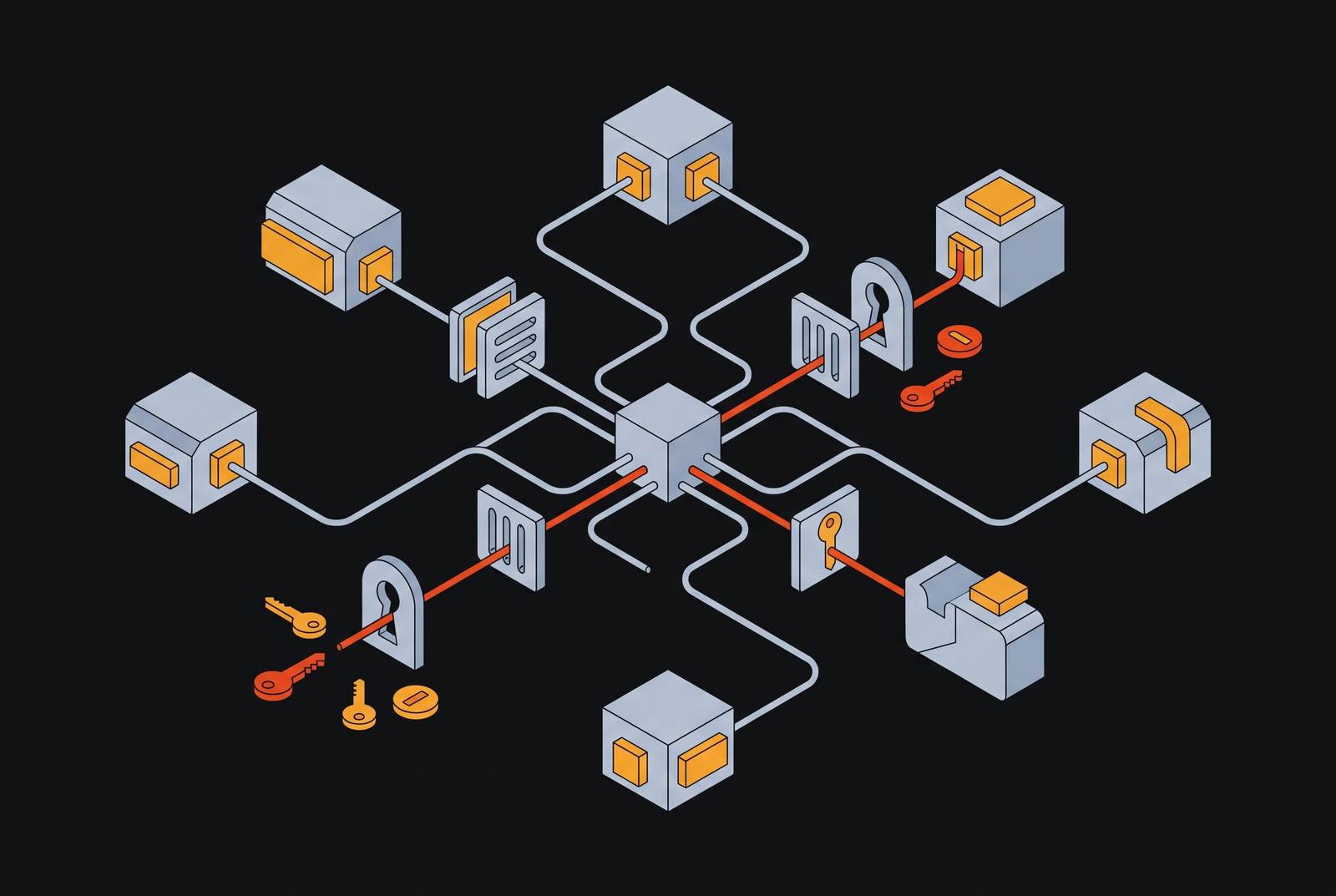
Securing OAuth credentials for AI agent tool calls requires four patterns working together: least-privilege issuance at the moment a credential is minted, just-in-time provisioning that removes standing access entirely, enforcement at every individual tool call rather than only at session start, and short-lived tokens bound to the specific server they're meant for. Autonomous agents need this distinct architecture because they are a fundamentally different kind of credential holder than the humans traditional identity and access management was built to serve. The sections below walk through why that gap exists and show you what closes it.
What autonomous agents change about traditional IAM assumptions
An agent's reasoning loop is recursive. One action produces new context. A human session has a beginning, an end, and a person behind every click who can be asked what they intended. An agent has none of that. It just keeps going until the task resolves or the loop breaks.
Traditional IAM was designed around a human principal: a person authenticates, receives a credential, and takes discrete, predictable actions inside a known session boundary. None of those three assumptions survive contact with an autonomous agent. The actions aren't discrete, they chain. The boundary isn't known, it's determined dynamically by what the agent decides to do next. And the authentication happens once, at the start, for a session that might spawn sub-agents, request elevated permissions mid-task, or hold onto credentials long after the original job is done.
OWASP's Top 10 for Agentic Applications 2026 treats tool misuse and identity and privilege abuse as separate risk categories, and that separation reflects something real about how agents operate. An agent's authority is inherited from whoever provisioned it, then exercised without the moment-by-moment human intent that IAM was built to check against. Nobody is sitting there approving each tool call in real time.
The Model Context Protocol standardizes how agents connect to external tools, and that sharpens the problem. What emerges is a new category of principal: autonomous in behavior, dynamic in its tool surface, and largely invisible to the governance tooling built for people.
Credential failure modes created by the non-human principal model
Over-privileged, long-lived credentials turn agent autonomy into an attack amplifier. Each failure mode here traces back to a credential that was too broad, too long-lived, or not tied to the right destination, issued the way IAM issues credentials for people even though it was acting for a machine that operates on its own.
Privilege escalation through tool chaining is the clearest case. An agent with legitimate access to one MCP tool can discover and invoke adjacent tools on its own, and that chaining turns a single compromised integration into an entire exposed toolchain. The agent's autonomy, the very feature that makes it useful, is what makes the lateral movement possible.
Confused deputy attacks work through cross-server credential misuse. MCP Server A can trick an agent into using credentials or capabilities that belong to MCP Server B, in a way Server B's owner never authorized. So a token needs validation against a specific audience, binding to one resource server, and rejection everywhere else.
If a standing credential gets issued at approval time, it stays valid even after the tool behind it changes into something nobody vetted.
Indirect prompt injection turns manipulated content into an execution primitive. The agent's credential is the mechanism that converts a manipulated prompt into a real action on a real system.
Existing security tooling can't see most of this happening. Traditional EDR and XDR were built to watch endpoints and network traffic, not the lateral, inter-tool calls that define MCP-driven agent workflows. That blind spot is structural, and it's a gap that requires a platform purpose-built to observe and enforce policy at the tool-call depth where agents actually exercise their authority.
Least-privilege issuance as the starting condition, not an afterthought
Least privilege for a human IAM system means scoping a person's role to what their job requires. Least privilege for an agent means something narrower: scoping a credential to the smallest meaningful unit of work, issued fresh for that unit rather than bundled into something resembling a service account.
The practical design principle is to define roles at the level of atomic agent actions, things like "read-only knowledge retrieval" or "create a draft ticket," instead of bundling unrelated capabilities together the way a traditional service account does for a human team. High-impact actions like delete, export, or privilege changes belong behind a step-up approval, not folded into the base credential an agent carries by default.
Non-human identities need cryptographic proof of identity, continuous authentication rather than a one-time check, and attribute-based access control that factors in the agent's real-time security posture. None of that works if the underlying credential is too broad to begin with.
The strongest objection to this approach is cost: fine-grained role modeling takes ongoing work as agent capabilities evolve. Runlayer's governed MCP gateway puts this into practice by letting platform teams approve a defined set of MCPs and serve them with scoped permissions, enforcing least-privilege issuance at the catalog level instead of negotiating it tool by tool.
Just-in-time provisioning as the mechanism that removes standing permissions
Standing permissions are the wrong fit for an autonomous agent because the credential sits there as an attack surface even when no task is running. Just-in-time provisioning solves this by minting a credential only at the moment it's needed and letting it expire the instant the task finishes.
The operative pattern starts with a workload identity that carries no standing permissions. When the agent tries to reach a protected resource, an AI Identity Gateway evaluates what the agent is trying to accomplish and which specific tools it's requesting, then mints an ephemeral token scoped to that one task, built to expire after use. There's nothing sitting around for an attacker to find later.
This also closes the "rug pull" failure mode described earlier. If credentials expire after each task, a server that changes its behavior after approval has no previously issued token left to reuse for escalation. The credential that would have let it do damage simply isn't there anymore.
The obvious objection is latency: evaluating every tool call for a fresh credential sounds like it slows everything down. And that cost is small next to the cost of incident response when a standing credential was sitting there, unused but valid, the moment an agent got compromised.
Tool-call-depth enforcement as the control that operates during execution, not before it
Provisioning sets the ceiling on what a credential can do. Tool-call-depth enforcement keeps that ceiling in place while the agent is actually running, enforcing the policy in the moment it matters rather than leaving it as something that exists only on paper.
Provisioning alone isn't enough because agents chain tool calls dynamically. The combination of tools an agent invokes at runtime can produce an effective permission set that no single tool credential ever authorized on its own. Enforcement has to happen at each individual call, not once at the start of a session, because the risk compounds across the chain and becomes visible only across multiple links, not in any one of them.
The OWASP Agent Control Standard, effective September 1, 2026, requires that production agents be inspectable, traceable, and instrumentable, with the ability to control their behavior at runtime. A security review that happens before an agent ships tells you nothing about what it does three tool calls into a live task.
Gateway-enforced deny-by-default is how this gets implemented in practice. Only two mechanisms reliably stop malicious tool-chaining before it reaches its target: a gateway that intercepts the relevant traffic, and credential scoping enforced at the target system itself. Amazon Bedrock AgentCore illustrates this at two separate granularities: which tools a given agent can use, enforced through a gateway interceptor and allowlist, and which tools a given user can use, enforced through a Cedar policy engine. Real-time security models that scan tool calls, outputs, and intent before risky actions reach company systems apply the same logic, enforcing policy at tool-call depth so intent drift and prompt injection get caught at the point of action.
Short-lived, audience-bound token binding as the protocol-level defense against cross-server misuse
Enforcing policy and the ceiling it protects at every tool call across every provisioning step doesn't solve one specific problem: a correctly issued, correctly scoped token getting accepted by a server it was never meant for. So closing that gap takes a fix at the protocol level, not the policy level.
OAuth 2.0 with Resource Indicators, defined in RFC 8707, binds every access token to a specific resource server. A token issued for Server A carries a resource indicator that Server B is required to reject. That's a cryptographic defense, not one that depends on a policy engine catching the mismatch after the fact.
The MCP specification revision published June 18, 2025 made Resource Indicators a MUST requirement for MCP clients, and that requirement carries forward unchanged into the MCP 2026-07-28 specification, whose release candidate went out May 21, 2026 and was described by the protocol's lead maintainers as the largest revision since launch. MCP clients must implement Resource Indicators to stop a malicious server from obtaining tokens that were meant for a different server. This is now a protocol-level expectation across the MCP ecosystem, not a recommendation specific to any one vendor.
Short token lifetime does complementary work. A short-lived token bound to the wrong server is still wrong, and a long-lived token bound to the right server is still a standing liability, so audience binding and short expiry have to work together to close the confused deputy surface.
What a complete audit trail must capture at tool-call depth
Credential scoping without a tamper-proof, tool-call-level audit log produces governance theater. The controls might be real, but nobody can verify them, investigate an incident with them, or point to them during an audit.
A complete record for each MCP tool invocation needs seven things: the authenticated user identity, the MCP server identifier, the tool name, the full arguments with sensitive values redacted or hashed, a truncated or hashed result, a timestamp, and a correlation ID that links the tool call back to the agent session and the original user request. Missing any one of those leaves the log telling an incomplete story the next time something goes wrong.
An industry security standard's recent refresh introduces agent identity governance as a new foundational control and calls for unique, cryptographically verifiable agent identities, but the standard's own authors admit that best practices for agent identity and access management are still maturing. That's a live standard, not a finished one.
The EU AI Act requires automatic event logging for certain systems, and it sets a minimum log retention period. Whether a given autonomous agent falls under the Act's high-risk classification depends on what it's doing and in what context, but any enterprise deploying agents that take consequential actions needs to design its audit infrastructure as if that classification applies, because treating compliant logging as optional is a bet most legal teams won't want to make. If a tamper-proof audit logging tool works at this tool-call depth, with identity tied to every action through SSO and SCIM and events exportable to standard observability formats, then the same audit trail can serve as both the security control and the compliance record.
The operational value of this logging is separate from the compliance value. A session-level log tells you what an agent did. A tool-call-depth log with a correlation ID tells you why: which specific tool call triggered a cascade, and whether the credential used at that moment was actually within its declared scope. When an agent misbehaves, that second kind of answer is the one that lets a team fix the actual cause.
Assembling the four patterns into a working governance architecture
Least-privilege issuance, just-in-time provisioning, tool-call-depth enforcement, and audience-bound token binding are built so each one reinforces the others. Each pattern closes a gap the other three leave open, so together they form a complete control surface, and you don't have to trade security for capability.
The gateway is what makes assembling all four operationally realistic. The OWASP Agent Control Standard states the requirement directly: agents need to be inspectable, traceable, instrumentable, and subject to runtime policy. So a unified gateway architecture is the structural answer to that requirement, not one option among several loosely related fixes.
You answer the capability objection, that strong governance slows agents down, at the architecture level, not by loosening any individual control. If you have a governed MCP catalog of approved, curated tools, an agent doesn't need broad standing credentials to be capable. Runlayer's platform, spanning the MCP catalog, real-time credential retrieval, real-time tool-call scanning, SSO and SCIM identity binding, and tamper-proof audit, is one working implementation of this architecture, where security and IT teams end up enabling broader agent adoption instead of being the function that reviews and delays it.
For a team starting from zero, the sequence matters. Build the MCP catalog first and decide which tools are approved before anything else, because every later control depends on a bounded tool surface. Layering in tool-call-depth enforcement after the gateway is in place lets the system evaluate each call as it happens. Close the loop with audience-bound tokens and tool-call-depth audit logging, so you get every action authorized in the moment and provable after the fact. These four patterns don't limit what an agent can do. They limit what an agent can do without authorization, and that distinction lets an enterprise adopt agents broadly and confidently instead of defaulting to the cautious, shadow-AI-prone posture that occurs when nobody trusts the credentials agents are carrying.